This paper explores the intersection of David Hume’s empiricism and Nāgārjuna’s Madhyamaka philosophy as a framework for rethinking artificial intelligence. Hume’s bundle theory of the self and Nāgārjuna’s doctrine of emptiness both reject the notion of intrinsic identity, portraying persons and phenomena as dynamic processes rather than enduring substances. Recent scholarship suggests Hume may have encountered Buddhist ideas through Jesuit intellectual networks linking Asia and Europe, illustrating how cross-cultural dialogue shaped early modern philosophy. Read together, these perspectives illuminate the nonessential nature of AI systems. AI is not a metaphysical “machine mind” but a contingent constellation of algorithms, data, hardware, and social contexts. This process view emphasizes relational ethics, situating responsibility in human networks of design and governance, and encourages design humility by resisting myths of autonomous superintelligence. By adopting a fusion philosophy that draws on both Western empiricism and Buddhist metaphysics, we can approach AI as an interdependent, impermanent phenomenon, fostering more responsible and globally informed governance in the digital age.
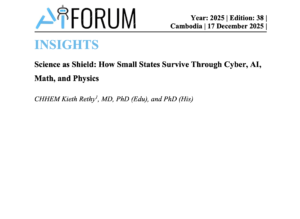
Released: 17 December 2025Author: CHHEM Kieth Rethy, MD, PhD (Edu), and PhD (His)
This article argues that for small states, survival in an era shaped by great power rivalry, war economy dynamics, and artificial intelligence depends on scientific…
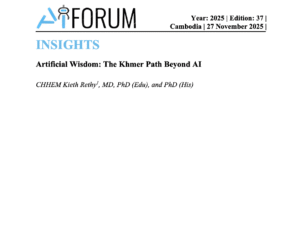
Released: 30 November 2025Author: CHHEM Kieth Rethy, MD, PhD (Edu), and PhD (His)
The Khmer Path Beyond AI explores how a mistranslation of “artificial intelligence” in Cambodia opened a deeper conversation about the difference between intelligence and wisdom.…
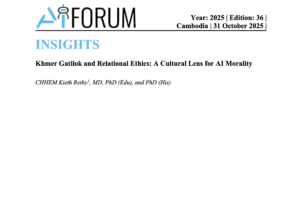
Released: 31 October 2025Author: CHHEM Kieth Rethy, MD, PhD (Edu), and PhD (His)
This essay examines the Khmer ethical system of Gatilok as a culturally grounded framework for AI ethics. Unlike Western approaches that prioritize universal principles, Gatilok…
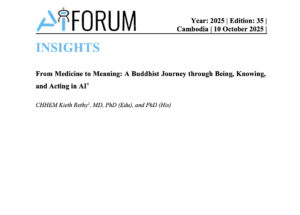
Released: 10 October 2025Author: CHHEM Kieth Rethy, MD, PhD (Edu), and PhD (His)
The essay explores how Buddhist philosophy can reshape the way we understand and design artificial intelligence. It argues that AI should not be seen as…
Released: 14 September 2025Author: SAY Vithya Arthur, MA in Business Innovation (MBI) | ROS Sayumphu, MA in Security, Conflict and International Development, LLM in International Law
Artificial Intelligence (AI) is transforming healthcare, transportation, and communication. This article traces the evolution and categorization of AI, while exploring ethical concerns such as bias…
Released: 13 September 2025Author: ROS Sayumphu, MA in Security, Conflict and International Development, LLM in International Law | CHHEM Siriwat, Ph.D. Candidate in Leadership, Master of Digital Technology Management (MDTM), Master of Arts in Diplomacy
This article explores the geopolitics of mobile phone applications as platforms that shape digital sovereignty and global power. With billions of internet users and mobile…