2025

AIF Insights No. 27 (2025) | Generosity and Its Limits: Reflections from Buddha, Nietzsche, and the AI Machine

Release: 2025-07-03
Author: CHEAB Sambath, MD | CHHEM Kieth Rethy, MD, PhD (Edu), and PhD (His)

This reflection explores the nature and limits of generosity through three lenses: Nietzsche’s emotionally burdened giver, Theravāda Buddhism’s selfless Arahat, and the emotionally neutral assistance offered by artificial intelligence (AI). Nietzsche shows how giving tied to ego and recognition can lead to suffering. Buddhism offers a path to pure giving—free from attachment, desire, or expectation.Continue reading "AIF Insights No. 27 (2025) | Generosity and Its Limits: Reflections from Buddha, Nietzsche, and the AI Machine"

Read More →

AIF Insights No. 26 (2025) | Artificial Intelligence and the Future of International Law: Challenges and Pathways Forward

Release: 2025-07-02
Author: PONG Pich, MA in Public Law

This article examines the growing impact of Artificial Intelligence (AI) on international law, focusing on the legal, ethical, and governance challenges it presents. AI technologies, which often operate autonomously and beyond traditional state control, are straining existing legal frameworks built around state-centric responsibility and territorial sovereignty. The paper explores key legal dilemmas such as attributionContinue reading "AIF Insights No. 26 (2025) | Artificial Intelligence and the Future of International Law: Challenges and Pathways Forward"

Read More →

AIF Insights No. 25 (2025) | Charting Cambodia’s AI-Driven Education Future: Policies, Readiness, and Reform

Release: 2025-07-01
Author: KHEANG Kimsuan, BA in International Relations | PONG Pich, MA in Public Law | TANN Thangvansounary, BA in Law

This article explores Cambodia’s evolving approach to integrating Artificial Intelligence (AI) into its education system, examining key policies, opportunities, challenges, and future directions. As the country pursues education reform under the Pentagonal Strategy, AI is viewed as a potential tool to improve equity, quality, and efficiency. The paper outlines national and international collaborations, including Cambodia’sContinue reading "AIF Insights No. 25 (2025) | Charting Cambodia’s AI-Driven Education Future: Policies, Readiness, and Reform"

Read More →

AIF Insights No. 24 (2025) | AI Cannot Teach What It Does Not Possess: Intelligence or Wisdom

Release: 2025-06-02
Author: CHHEM Kieth Rethy, MD, PhD (Edu), and PhD (His)

This article critically examines the growing integration of Artificial Intelligence (AI) in education, arguing that AI fundamentally lacks the intelligence and wisdom necessary for meaningful teaching. While AI tools offer administrative efficiencies and personalization, they cannot replicate the moral judgment, emotional presence, or relational depth essential to human learning. The author asserts that education mustContinue reading "AIF Insights No. 24 (2025) | AI Cannot Teach What It Does Not Possess: Intelligence or Wisdom"

Read More →

AIF Insights No. 23 (2025) | From Human Beings to Human Inter-Beings: Rethinking AI Through Relational Ontology

Release: 2025-05-24
Author: SONG Sopheak, PhD (Edu) | CHHEM Kieth Rethy, MD, PhD (Edu), and PhD (His)

This paper, From Human Beings to Human Inter-Beings: Rethinking AI Through Relational Ontology, challenges the dominant Cartesian paradigm of artificial intelligence grounded in individual cognition (“I think, therefore I am”). Drawing from Buddhist and Confucian philosophies, the authors propose an alternative ontological foundation: “We behave, therefore we are.” This perspective emphasizes relationality, interdependence, and ethicalContinue reading "AIF Insights No. 23 (2025) | From Human Beings to Human Inter-Beings: Rethinking AI Through Relational Ontology"

Read More →

AIF Insights No. 22 (2025) | Dependent Origination and Systems Thinking: A Buddhist Logic for Explainable AI

Release: 2025-05-18
Author: CHEAB Sambath, MD | CHHEM Kieth Rethy, MD, PhD (Edu), and PhD (His)

This chapter explores how the Buddhist principle of pratityasamutpada (dependent origination) can enrich explainable AI (XAI) by offering a systems-based, relational understanding of causality. Challenging linear and reductionist models, it argues for a paradigm of situated explainability rooted in interdependence, contextuality, and moral awareness. Drawing parallels between Buddhist logic and systems thinking, the chapter advocatesContinue reading "AIF Insights No. 22 (2025) | Dependent Origination and Systems Thinking: A Buddhist Logic for Explainable AI"

Read More →

AIF Insights No. 21 (2025) | Anattā and the Myth of AI Autonomy: Towards a Processual and Relational Ethic for Artificial Intelligence

Release: 2025-05-18
Author: CHEAB Sambath, MD | CHHEM Kieth Rethy, MD, PhD (Edu), and PhD (His)

This chapter interrogates the prevalent notion of AI autonomy through the lens of Theravāda Buddhist philosophy, particularly the doctrine of anattā (non-self) and the analytical framework of the pañcakkhandhā (five aggregates). It critiques the anthropomorphic portrayal of AI as independent, self-sustaining agents, arguing instead that both human beings and artificial systems are best understood asContinue reading "AIF Insights No. 21 (2025) | Anattā and the Myth of AI Autonomy: Towards a Processual and Relational Ethic for Artificial Intelligence"

Read More →

AIF Insights No. 20 (2025) | Buddha: Proto-Neuroscientist and Forerunner of AI Thought

Release: 2025-05-18
Author: CHHEM Kieth Rethy, MD, PhD (Edu), and PhD (His)

This essay proposes that Siddhartha Gautama, the historical Buddha, can be seen as a proto-neuroscientist and early theorist of artificial intelligence. Through systematic introspection, ethical discipline, and meditative practices, the Buddha developed a sophisticated cognitive framework that parallels modern discoveries in neuroscience, psychology, and AI. His teachings on dependent origination resemble feedback and predictive codingContinue reading "AIF Insights No. 20 (2025) | Buddha: Proto-Neuroscientist and Forerunner of AI Thought"

Read More →

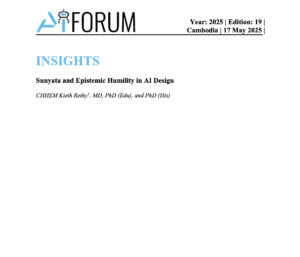
AIF Insights No. 19 (2025) | Sunyata and Epistemic Humility in AI Design

Release: 2025-05-18
Author: CHHEM Kieth Rethy, MD, PhD (Edu), and PhD (His)

This paper explores the Mahayana Buddhist concept of sunyata—emptiness—as a foundation for cultivating epistemic humility in the design of artificial intelligence (AI) systems. Rather than denoting nihilism, sunyata refers to the absence of intrinsic, independent existence in all phenomena, emphasizing interdependence, context, and impermanence. Applying this lens to AI challenges the essentialist and overly deterministicContinue reading "AIF Insights No. 19 (2025) | Sunyata and Epistemic Humility in AI Design"

Read More →

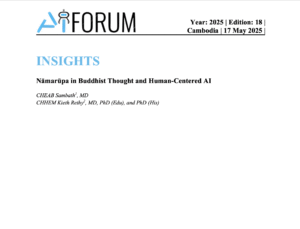
AIF Insights No. 18 (2025) | Nāmarūpa in Buddhist Thought and Human-Centered AI

Release: 2025-05-18
Author: CHEAB Sambath, MD | CHHEM Kieth Rethy, MD, PhD (Edu), and PhD (His)

This paper explores the Buddhist concept of nāmarūpa—“name and form”—and its relevance to the development of human-centered artificial intelligence (AI). Rooted in the principle of dependent origination, nāmarūpa describes the interdependence of mental and physical phenomena, emphasizing impermanence, co-arising, and ethical intentionality. The authors argue that this philosophical framework offers valuable guidance for AI designContinue reading "AIF Insights No. 18 (2025) | Nāmarūpa in Buddhist Thought and Human-Centered AI"

Read More →

AIF Insights No. 17 (2025) | Theravada Buddhism: Mindfulness for the Ethical Advancement of AI

Release: 2025-05-16
Author: CHEAB Sambath, MD | CHHEM Kieth Rethy, MD, PhD (Edu), and PhD (His)

Artificial intelligence (AI) raises significant ethical concerns regarding justice, transparency, and responsibility, demanding novel approaches to mitigate risks like algorithmic discrimination and social exclusion. This commentary investigates how Theravada Buddhist mindfulness (sati) offers a transformative ethical foundation for AI development. Mindfulness fosters self-awareness and wisdom, enabling developers to identify biases, such as those in hiringContinue reading "AIF Insights No. 17 (2025) | Theravada Buddhism: Mindfulness for the Ethical Advancement of AI"

Read More →

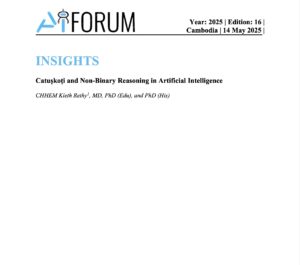
AIF Insights No. 16 (2025) | Catuṣkoṭi and Non-Binary Reasoning in Artificial Intelligence

Release: 2025-05-14
Author: CHHEM Kieth Rethy, MD, PhD (Edu), and PhD (His)

This article explores the application of catuṣkoṭi, a four-fold logic system rooted in Buddhist Madhyamaka philosophy, as a framework for advancing artificial intelligence (AI), particularly in areas where binary logic falls short. Classical Aristotelian logic, foundational to most AI systems, operates on binary distinctions (true or false), which often prove inadequate for modeling ambiguity, contradiction,Continue reading "AIF Insights No. 16 (2025) | Catuṣkoṭi and Non-Binary Reasoning in Artificial Intelligence"

Read More →